02
What lion’s mane is
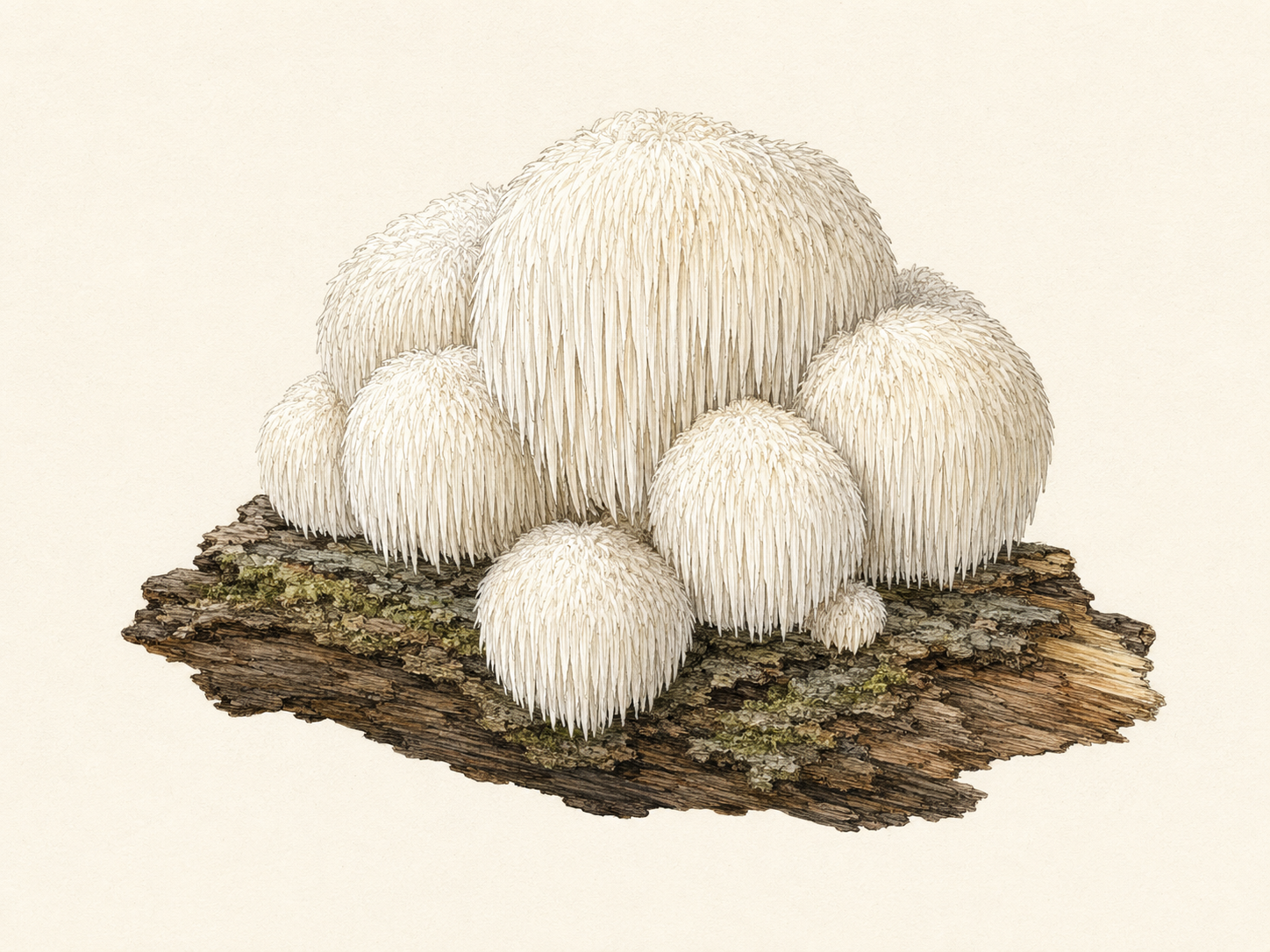
Lion’s mane forms white, cascading teeth rather than a typical cap. It is both a culinary mushroom and a supplement ingredient. Products may use the fruiting body, cultured mycelium, or both, and those are not chemically interchangeable.
“Functional mushroom” is a wellness category, not a regulatory standard. A product can use the phrase without proving identity, composition, safety, or benefit. Start with the Latin name and the actual material, not the promise on the front.
03
What the research suggests
Human evidence: promising but limitedSeveral small human studies have reported possible changes in cognitive test scores or stress-related measures. Sample sizes have been modest, preparations differ, and results have not established a general cognitive benefit.
Laboratory work on hericenones and erinacines helps explain why researchers are interested in the species, but a mechanism observed in cells or animals is not the same thing as a demonstrated benefit in people.
There is no good evidence that lion’s mane cures dementia, repairs nerve damage in humans, or can replace mental-health or neurological care.
04
How people take it and dosage context
Supplements are sold as powders, capsules, tinctures, and extracts. There is no universally established clinical dose for consumer products. Follow the tested product label, avoid stacking multiple formulas at once, and ask a clinician about use during pregnancy, with chronic illness, or alongside medication.
| Format | What to check | Limit |
|---|---|---|
| Whole powder | Species, mushroom part, serving, starch and beta-glucans | Less concentrated; composition still varies. |
| Extract | Solvent, ratio, final beta-glucans or marker compounds | An extract ratio alone does not show quality. |
| Tincture | Species, solvent, concentration, serving | Alcohol and water capture different compounds; drops are not standardized. |
| Blend | Amount of every species | A large blend can hide very small individual amounts. |
05
Side effects and who should be cautious
Possible effects include stomach upset, itching, or allergic reactions, particularly in people sensitive to mushrooms. Stop use and seek care for breathing trouble, swelling, or a severe rash.
Dietary supplements are not reviewed like prescription drugs before sale. “Natural” does not mean interaction-free. Bring the label and, if available, a current certificate of analysis when asking a clinician or pharmacist.
06
What to look for when buying
- The label names Hericium erinaceus
- The mushroom part is disclosed
- Beta-glucans are measured, not just total polysaccharides
- An independent lab checks microbes, heavy metals, and identity
- The serving amount and extract ratio are clear
Fruiting body vs. mycelium
Neither phrase wins automatically. They are different fungal materials with different compound profiles. A trustworthy company says what it used, whether grain or another substrate remains, how it extracted the material, and what the finished batch tested for.
Beta-glucans and testing
Measured beta-glucans are more useful than a broad total-polysaccharide claim, which may include starch. Look for a recent, lot-linked report covering identity, heavy metals, microbes, and relevant pesticides or adulterants.
FAQ
Common questions
Does lion’s mane work right away?+
There is no reliable evidence of an immediate, stimulant-like effect. Studies that reported changes generally looked across weeks, and results may not apply to every product.
Is fruiting body always better than mycelium?+
Not automatically. They contain different compounds. The useful question is whether the company identifies the material, explains the extract, and verifies composition rather than relying on a vague ‘mushroom complex’ label.
Can lion’s mane replace medical treatment?+
No. It is not an established treatment for dementia, depression, neuropathy, or another disease.
Sources